AI Agents vs. Chatbots: What's the Difference (and Which Does Your Business Need?)
Everyone's Talking About AI Agents. Here's What Actually Matters.
Open any business publication in 2026 and you'll see the phrase "AI agent" everywhere. Suddenly every tool is an "agent," every chatbot is "agentic," and the lines between the two have gotten genuinely blurry.
For business owners trying to make smart investments, this confusion is expensive. Buy the wrong thing and you either overpay for capability you don't need — or underbuy and end up with a tool that talks a good game but never actually does the work.
So let's cut through it. Here's the honest, practical difference between a chatbot and an AI agent, and how to know which one your business actually needs.
What a Chatbot Actually Does
A chatbot is a conversational interface. You ask it something, it responds. That's the core of it.
Modern AI chatbots are remarkably smart. They understand natural language, handle follow-up questions, speak multiple languages, and can be trained on your specific business knowledge. A well-built chatbot can answer customer questions, qualify leads, and even book appointments — all through a natural back-and-forth conversation.
But here's the defining trait: a chatbot reacts. It waits for a message, then responds. Its job is to communicate.
Think of it as your always-on front desk. It greets people, answers their questions, points them in the right direction, and captures their information. It's genuinely valuable — but its world begins and ends with the conversation.
What Makes an AI Agent Different
An AI agent goes a step further. Instead of just responding, an agent acts.
An agent is given a goal, and it figures out the steps to achieve that goal on its own. It can break a complex task into pieces, decide which tools to use, take actions across multiple systems, check its own work, and keep going until the job is done — with little or no hand-holding.
Where a chatbot talks, an agent works.
A few concrete examples of what an agent can do that a plain chatbot can't:
- Research a competitor, summarize the findings, and email the report to your team — unprompted, on a schedule.
- Watch your inbox, and when an invoice arrives, extract the details, log them in your spreadsheet, and flag anything unusual.
- Take a customer request from a chat, then actually complete the multi-step process behind the scenes — checking availability, updating your calendar, sending confirmations, and following up.
The agent doesn't just tell you what could be done. It does it.
A Simple Way to Tell Them Apart
If you remember nothing else, remember this:
A chatbot answers. An agent accomplishes.
Chatbot:
- Core job — converse and respond
- Trigger — reacts to your message
- Scope — a single conversation
- Autonomy — low, a back-and-forth exchange
- Best for — FAQs, lead capture, booking appointments
AI Agent:
- Core job — plan and take action
- Trigger — pursues a goal you set
- Scope — multi-step, multi-tool tasks
- Autonomy — high, works independently
- Best for — research, data work, workflow orchestration
Neither is "better." They solve different problems. The mistake is expecting a chatbot to do an agent's job, or paying for an agent when a chatbot would have been perfect.
When a Chatbot Is Exactly What You Need
For a huge number of businesses, a well-built chatbot is the highest-ROI starting point. You want a chatbot when your main pain is communication:
- Customers keep asking the same questions, and your team is drowning in repetitive replies.
- You're losing leads because nobody responds after hours or on weekends.
- You want to capture and qualify leads, and book appointments automatically.
This is exactly the problem we solve for clinics and service businesses. A dental practice, for instance, doesn't need an autonomous agent running wild — it needs a friendly, bilingual assistant that answers patient questions instantly on Messenger and the website, and books appointments straight onto the calendar. A chatbot nails that, 24/7, for a fraction of the cost of extra front-desk staff.
If your bottleneck is talking to customers, start with a chatbot.
When You Need an AI Agent
You graduate to an agent when your pain is work, not conversation — repetitive, multi-step tasks that eat up your team's day:
- Manually moving data between tools (inbox → spreadsheet → CRM).
- Research and reporting that has to be gathered, summarized, and delivered regularly.
- Multi-stage processes where several systems need to be coordinated to finish one job.
If you find yourself saying "I wish something could just handle this whole thing for me," you're describing an agent.
The Real Power: Combining Both
Here's where it gets exciting — and where the best modern automation lives.
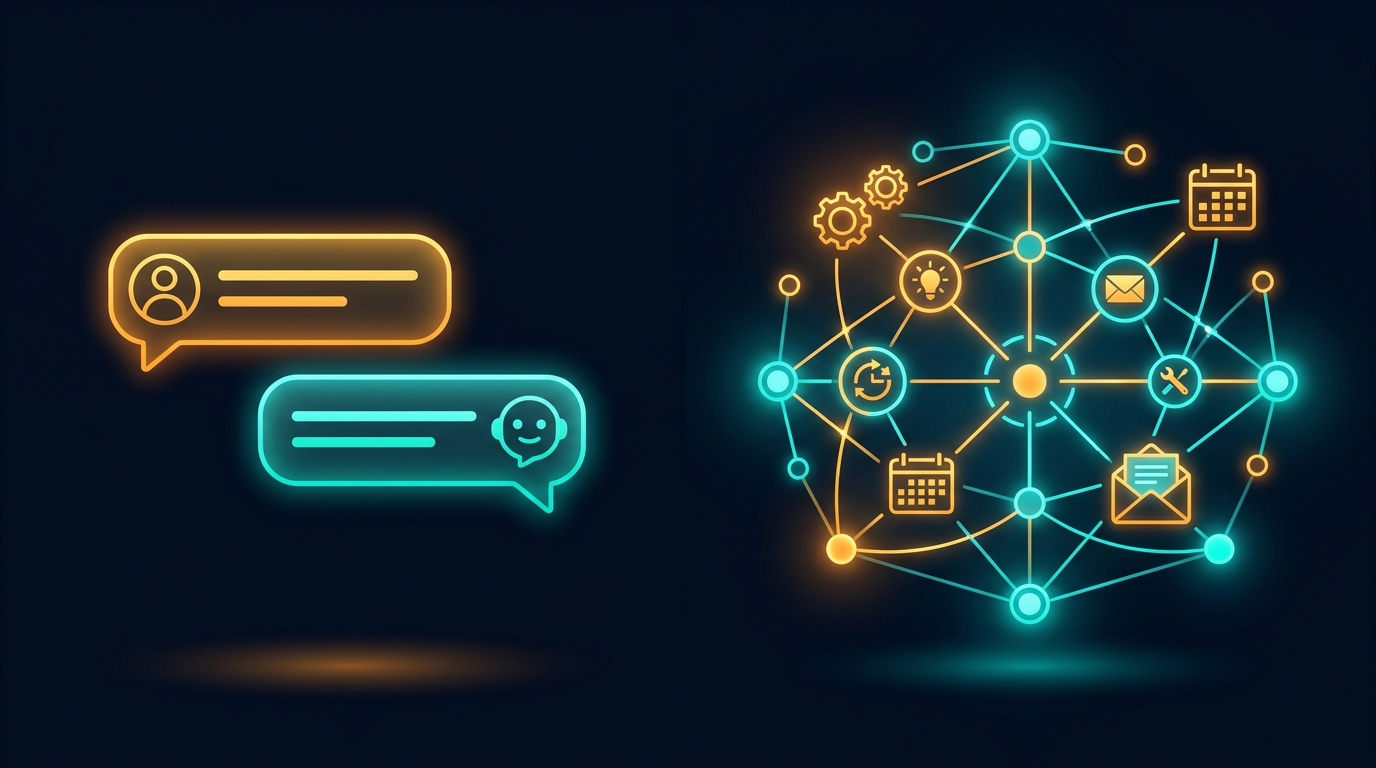
The most effective setups don't choose between a chatbot and an agent. They use a chatbot as the front door and an agent as the engine behind it.
The customer chats with a friendly, conversational interface (the chatbot). But behind the scenes, an agent is doing the real work — checking your calendar, updating records, sending confirmations, and triggering follow-ups across your tools. The customer experiences a simple conversation. You get an entire workflow handled automatically.
That combination — conversational on the surface, autonomous underneath — is what turns AI from a neat feature into a genuine competitive advantage.
So Which Does Your Business Need?
Ask yourself one question: Is my biggest problem talking to customers, or doing the work behind the scenes?
- Talking → start with a chatbot. It's faster, cheaper, and delivers immediate, measurable results.
- Doing → you're ready for an agent that can take tasks off your plate entirely.
- Both → the sweet spot: a conversational front end powered by autonomous agents underneath.
You don't need to figure out the architecture yourself. You need a partner who's built both and knows which one actually moves the needle for your specific business.
At NextEra Of AI, we build custom chatbots, AI agents, and the automated workflows that connect them — tailored to how your business actually runs, not a one-size-fits-all template.
Not sure whether you need a chatbot, an agent, or both? Book a free consultation and we'll map out exactly what would make the biggest difference for you.
John Michael Dela Pena
Author at NextEra AI